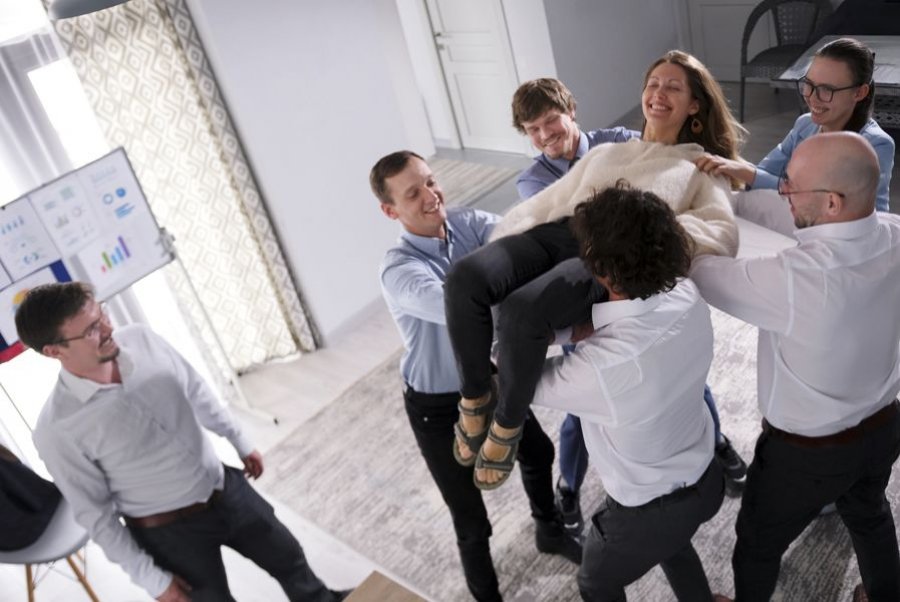
Do you remember the old Team-Building days? This may have meant stepping away from the office for a day of practical challenges; problem-solving games, trust exercises, or perhaps something more adventurous involving, rope bridges and ambitious raft building that may or may not have floated.
While these experiences created memorable moments (and plenty of office stories), the true purpose behind team building sometimes became overshadowed by the activity itself. The games were never really the point. The outcomes were.
Today, as hybrid and flexible working reshape how colleagues interact, organisations are rediscovering that the intent behind team building remains critically important; perhaps more so than ever.
The Real Purpose of Team Building
At its core, effective team building has always focused on strengthening the fundamentals of organisational performance. Well-designed programmes aim to:
- Improve communication between individuals and departments
- Encourage teams to work towards shared goals
- Help individuals recognise their own strengths and development areas, and those of colleagues
- Build awareness of colleagues’ working styles
- Promote camaraderie, trust and psychological safety
In pre-pandemic workplaces, many of these benefits occurred naturally through daily interaction. Today’s more dispersed workforce, as a result of hybrid and flexible working options means connection must be developed more intentionally. Modern team building has therefore evolved from one-off events into structured development initiatives grounded in behavioural science and leadership theory.
One example of this shift can be seen in programmes such as the Insights Discovery, programme that is part of our training and development portfolio. Rather than relying on physical challenges, this approach focuses on understanding how individuals think, communicate and contribute within a team.
Insights Discovery uses a colour-based framework, assigning individuals preferences aligned broadly to four colour energies. By understanding both our own profile and those of our colleagues, teams gain practical insight into communication styles, decision-making approaches and motivational drivers.
The result is highly applicable workplace learning. Teams become better equipped to adapt communication, collaborate more effectively and deploy the right strengths for specific tasks or projects. Instead of assuming alignment, organisations actively build it.
This represents a significant evolution of understanding of the elements required for truly effective team building.
The emphasis on collaborative performance also runs throughout the ILM accredited Leadership & Management training that we offer. Across all programme levels from Level 2 to Level 5, building and sustaining high-performing teams is a consistent and underpinning theme.
Leaders are encouraged to understand that team effectiveness is not accidental. It requires clarity of purpose, mutual accountability and an environment where individuals feel empowered to contribute. Strong leadership creates alignment within the team which delivers results.
One of the frameworks we often reference within our leadership training is the Tuckman's stages of group development. This model describes how teams naturally progress through stages of Forming, Storming, Norming and Performing.
Crucially, the “Storming” phase, where differences emerge and conflict can arise, is both normal and necessary. Awareness of this process allows leaders and to manage tension constructively rather than viewing it as failure. When handled effectively, teams move beyond friction toward stronger collaboration and sustained productivity.
Without this understanding, organisations risk misinterpreting natural development challenges as interpersonal problems, potentially undermining performance.
With the continued economic uncertainty in the UK, rising unemployment figures and cautious business forecasting, organisational resilience has never been more important. During uncertain periods, it is cohesive and adaptable organisations that succeed and even thrive.
Teams that communicate effectively, understand one another’s strengths and work toward shared objectives are better positioned to navigate change, maintain morale and sustain productivity under pressure.
In short, stable organisations are built on strong teams, but strong teams do not happen by chance, they must be nurtured and developed.
If you would like to explore how structured training and leadership development can help build a collaborative, high-performing workforce led by inspirational leaders, contact us to discuss how we can support your organisation in developing stronger, more effective teams for the future. Call us on 01452 331331, or complete the contact form.